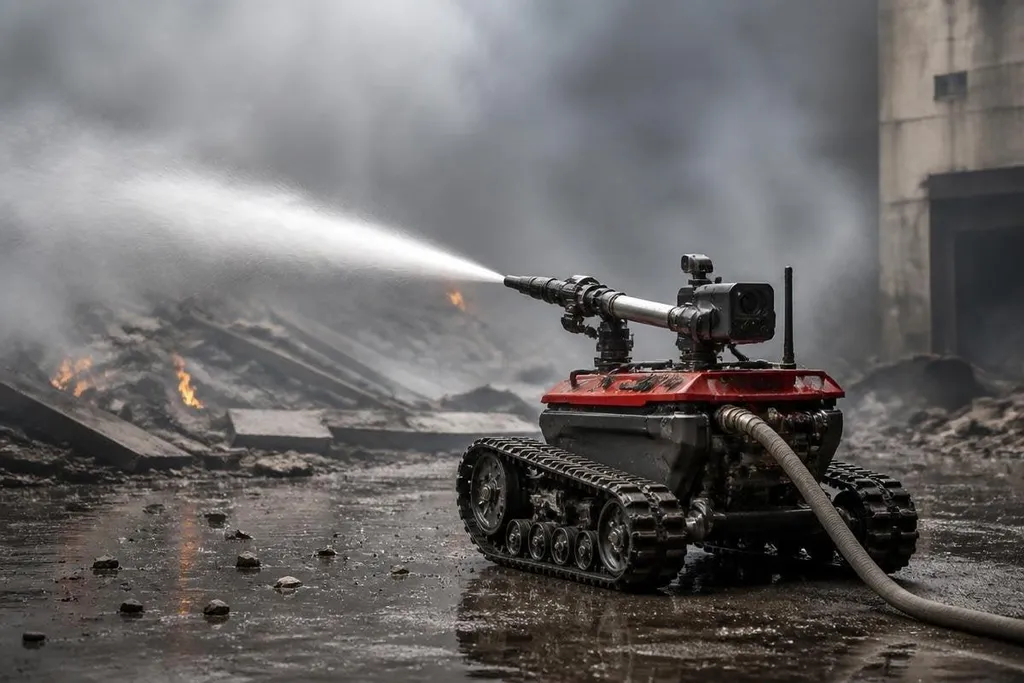
A firefighting robot has to find heat, carry its own water plan, and keep working when people must stay back. A clean floor and bright warehouse demo tell you little about that job.
This article sets a practical test for the machines entering the field. Without verified source material for named robots, deployments, or prices, it does not rank a winner.
- Heat sensing matters only when smoke blocks normal cameras.
- A robot needs a clear way to reach the fire and return.
- The useful proof is a timed test in heat, water, rubble, and weak radio links.
What the robot has to do
The first task is finding the fire. A thermal camera can show hot areas through smoke, while a regular camera helps the operator read doors, stairs, and hoses. The system has to combine those views without hiding how sure it is.
That information matters because a firefighting team may send the robot ahead of people. The operator needs to know if the robot has found a flame, a hot wall, a vehicle engine, or a reflection from metal.
Movement brings a second problem. A tracked robot may cross loose ground and door thresholds, while a legged robot may handle steps more easily. Neither statement proves field value on its own. The test must name the surface, slope, step height, load, and time taken.
Water adds weight and force. A robot carrying a hose has to resist the push from the stream, keep its camera clear, and hold position near the fire. A nozzle that reaches far across an open room may still fail in a narrow passage.
Heat, smoke, and radio links
Fire scenes damage electronics before flames touch them. Heat can raise the temperature inside a sealed housing, smoke can cover sensors, and water can enter through joints or cable openings. A serious trial should record the temperature at the sensors and battery, not only the air outside the robot.
Communication creates another limit. An operator may control the robot from behind a wall, inside a vehicle, or near the edge of a building. The test should measure video delay, control delay, and the time needed to stop the robot after the link weakens.
That test record matters when a firefighting robot enters a smoke-filled building or works near collapsing walls. A buyer needs reports that name the machine, site, task, control link, and failure case, not a demo with no operating details. Firefighting robotics coverage from Robot24.com can connect those facts to published tests before the next point: safe behavior after contact fails.
A robot that loses its link should stop safely or return along a known route. It should not keep driving from an old command while the operator waits for a picture to come back.
The proof that matters
Manufacturers may show a robot pushing through smoke or spraying water at a target. Those scenes help.
They leave out the questions a fire service must answer before purchase: Who set up the course? How many runs passed? What failed? How long did recovery take?
The useful record has four parts: the scene, the task, the result, and the limits. A video should show the full run, including setup, pauses, blocked paths, loss of control, and the return trip.
I'd judge a firefighting robot by its failed runs as much as its clean ones. A machine that reports a sensor fault and stops in a safe place may be more useful than one that completes a short demo and gives no warning before losing control.
Cost also needs a full measure. The purchase price is only one line. Fire services may need spare tracks, batteries, chargers, training, transport, software support, and a crew member to operate the robot.
A field trial checklist
Before comparing a robot with another system, ask for these records:
- Heat test: temperature at the robot, sensors, battery, and control housing.
- Smoke test: camera view, thermal view, smoke type, and time until the operator lost useful sight.
- Movement test: surface, slope, steps, hose load, and distance covered.
- Water test: nozzle range, stream pressure, robot position, and recovery after a slip.
- Link test: video delay, control delay, dead zones, and safe-stop behavior.
- Service record: battery change time, cleaning steps, spare parts, and trained crew size.
These records turn a product video into a comparison. They also show where a robot belongs: a tunnel, a chemical plant, a warehouse, or an outdoor fire line may need different hardware.
What comes next
The race will be decided by repeatable trials, not by the number of machines shown at a trade event. Fire services should ask for full test videos, failure logs, service costs, and a clear plan for control loss before putting a robot near a live fire.
Until those records are public for each named system, the honest answer is that no global winner can be picked. The next useful number is the same for every contender: how many complete runs it finishes after the first failure.